
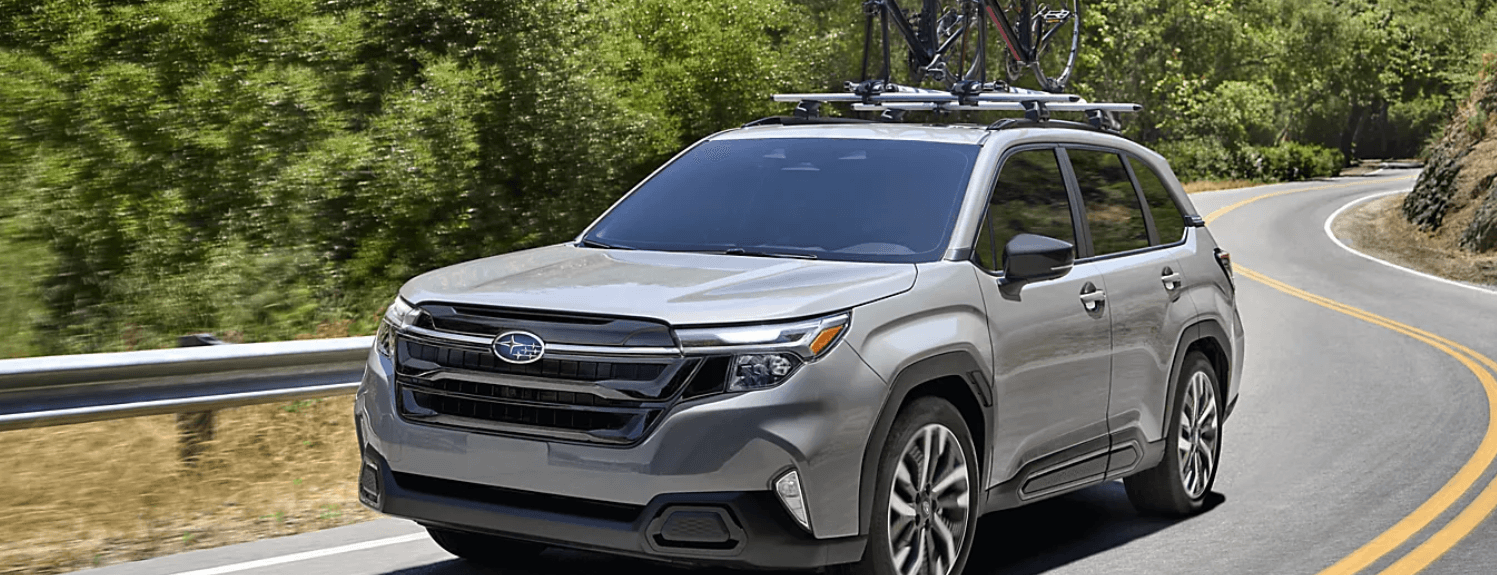
This content was aggregated from local dealer data and insights provided by the USA Today Network Automotive Insights team using Google Gemini and the Vehicles For Sale Near Green Bay - Appleton marketplace writing team.
Choosing a new Subaru Forester in Appleton involves more than comparing trim levels and exterior colors. For families, commuters, and drivers throughout the Fox Cities, the 2026 Subaru Forester's biggest appeal is its combination of passenger space, flexible cargo storage, everyday visibility, and standard all-wheel drive. Those features can make school drop-offs, grocery runs, winter commutes, and weekend trips more manageable. Before deciding whether the Forester is the right SUV, buyers should consider how its interior dimensions, seating layout, cargo access, and available technology fit their actual routines.
The Subaru Forester is a compact SUV designed to balance passenger comfort with cargo flexibility.
It offers more interior height and a more upright seating position than many sedans while remaining easier to maneuver than larger three-row SUVs.
For Appleton drivers, that combination can be particularly useful.
A typical day may involve commuting on Interstate 41, dropping children off at school, stopping at grocery stores, and navigating residential streets during winter weather.
The Forester's tall cabin, wide windows, and rear liftgate support those activities without requiring the size or operating costs of a larger SUV.
However, practicality depends on individual needs.
A vehicle that works well for a couple carrying weekend luggage may feel less spacious when transporting two child seats, a stroller, and several bags.
The strongest buying decision comes from evaluating the Forester's usable space rather than relying only on its published cargo-volume figures.
The Forester's relatively upright body design creates a cabin that feels open and accessible.
Its roof height provides useful headroom, while the elevated seating position can improve visibility of surrounding traffic.
For families, this can make entering and exiting the vehicle more convenient.
The rear seating area accommodates three passengers, although comfort depends on passenger size and whether child seats are installed.
The Forester is a five-passenger SUV, not a three-row vehicle.
Buyers who routinely transport six or more people will need to consider a larger vehicle.
For households that primarily carry four or five occupants, however, the Forester's interior layout can provide a useful balance of comfort and manageable exterior dimensions.
Cargo capacity is one of the Forester's most appealing qualities.
The rear liftgate provides a large opening for groceries, luggage, sports equipment, and other everyday items.
Folding the rear seats expands the available cargo area when passenger space is not needed.
Recent-generation Forester models have offered approximately 27.5 to 29.6 cubic feet of cargo space behind the rear seats and approximately 69.1 to 74.4 cubic feet with the rear seats folded, depending on configuration.
These figures are useful reference points, but actual 2026 measurements vary by powertrain, equipment, and trim.
Buyers should confirm the specifications of the vehicle they are considering.
More importantly, they should evaluate whether their own belongings fit comfortably.
A stroller, large dog crate, bicycle, or bulky storage container may fit differently than the cargo-volume number suggests.
The Forester lineup includes gasoline-powered configurations, with hybrid options available in the 2026 model family.
Different trims emphasize affordability, comfort, technology, efficiency, or rugged capability.
A lower trim may provide everything needed for commuting and family errands.
A more premium trim may offer additional seating comfort, convenience features, or upgraded interior materials.
A hybrid may appeal to drivers who prioritize fuel efficiency.
The Wilderness configuration is designed for buyers who want additional rugged capability.
However, the best value comes from selecting features that will be used regularly rather than automatically choosing the most expensive version.
The Forester's five-passenger cabin is designed to provide comfortable space for daily transportation.
Its upright seating position and relatively tall roof can be particularly helpful for taller occupants.
Front passengers benefit from good outward visibility, while rear passengers have useful headroom and legroom for a compact SUV.
However, buyers should test the cabin with realistic passenger arrangements.
For example, a family with two child seats should check whether the front seats can remain in comfortable positions after the child seats are installed.
A household with three rear-seat passengers should evaluate shoulder room and seating comfort.
For Appleton shoppers, these practical tests may be more valuable than comparing a few inches of published legroom.
Families considering the 2026 Subaru Forester should pay close attention to rear-seat access.
The Forester's taller roofline and conventional rear doors can make it easier to position children in car seats compared with some lower vehicles.
However, child-seat compatibility depends on the specific seat, installation method, and seating position.
Buyers should check the vehicle owner's manual and child-seat manufacturer's instructions.
The Forester's rear seat can accommodate multiple passengers, but three child seats across may not be practical with every seat combination.
For households with young children, bringing existing child seats to the dealership for a fit check can help avoid surprises.
The Forester's cargo area is designed for everyday versatility.
The following table provides recent-generation reference measurements.
Cargo Configuration | Approximate Volume |
Behind rear seats | 27.5–29.6 cubic feet |
Rear seats folded | 69.1–74.4 cubic feet |
Seating capacity | Five passengers |
Rear cargo access | Liftgate |
Rear-seat flexibility | Split-folding rear seat |
These are broad reference figures rather than independently verified specifications for every 2026 trim.
The amount of usable space can vary depending on equipment, cargo-floor height, and the shape of the items being transported.
A wide cargo opening may make loading bulky items easier, while the relatively upright rear body design can provide useful vertical storage space.
However, cargo should be secured properly and should not obstruct the driver's view.
For many Appleton households, the Forester offers enough space for everyday needs.
A grocery trip may require room for several bags, bulk purchases, and a stroller.
A school-day routine may involve backpacks, sports equipment, and other belongings.
The Forester's cargo area can accommodate many of these items without folding the rear seats.
For larger purchases, folding part or all of the rear seat creates additional flexibility.
However, families who frequently carry five passengers and substantial cargo simultaneously may find the available space limiting.
A larger SUV or minivan may be more appropriate for those needs.
The Forester's strongest advantage is its balance of passenger space and manageable size.
Subaru's Symmetrical All-Wheel Drive is a central part of the Forester's appeal.
The system helps distribute driving power and can improve traction during acceleration on slippery surfaces.
For Appleton drivers, this is relevant during snowy winters, freezing rain, and changing road conditions.
However, AWD does not guarantee shorter stopping distances on ice.
Tire quality remains essential.
Winter tires or suitable severe-snow-rated all-weather tires can improve traction in cold-weather conditions.
Buyers should consider the Forester's AWD system as part of an overall winter-driving strategy rather than a replacement for careful driving.
Recent Forester models have offered approximately 8.7 inches of ground clearance in conventional configurations.
The Wilderness version has offered additional clearance and more rugged-oriented equipment.
This can be useful for snow-covered driveways, uneven parking areas, and occasional outdoor travel.
However, buyers should consider how frequently they will use the additional capability.
For drivers who spend nearly all their time on maintained roads around Appleton, Neenah, Menasha, and Kaukauna, a conventional Forester may provide sufficient ground clearance.
The Wilderness is more compelling for shoppers who regularly encounter rougher surfaces or need its additional specialized features.
Recent gasoline-powered Forester models use a 2.5-liter SUBARU BOXER four-cylinder engine producing approximately 180 horsepower.
The engine works with a continuously variable transmission and standard all-wheel drive.
This combination is intended to provide practical acceleration and everyday efficiency.
The hybrid version combines a gasoline engine with electric assistance to improve fuel efficiency in suitable driving conditions.
For Appleton commuters who frequently encounter traffic lights and short trips, the hybrid may offer an operating-cost advantage.
However, buyers should compare official fuel-economy ratings and purchase prices before assuming the hybrid will deliver the best overall value.
The Forester Hybrid does not require external charging.
Safety technology is another important buying consideration.
The Forester offers Subaru EyeSight Driver Assist Technology, which includes features designed to support attentive driving.
Depending on trim and configuration, available systems may include:
Pre-Collision Braking
Adaptive Cruise Control
Lane Departure Warning
Lane Keep Assist
Lane Centering
Blind-Spot Detection
Rear Cross-Traffic Alert
Reverse Automatic Braking
Not every feature is standard on every trim.
For Appleton drivers who regularly travel on I-41 or Highway 441, adaptive cruise control and lane-related assistance may provide additional convenience during suitable highway conditions.
However, EyeSight is not a self-driving system.
Drivers must remain attentive and maintain control at all times.
Snow, ice, heavy rain, and obstructed cameras can also affect driver-assistance performance.
The Forester's infotainment and comfort features can influence how convenient it feels during daily use.
Depending on trim, available equipment may include:
Touchscreen infotainment
Apple CarPlay and Android Auto compatibility
USB charging ports
Available wireless smartphone charging
Heated front seats
Available heated steering wheel
Available power rear liftgate
Available panoramic moonroof
Available upgraded audio
For families, features such as heated seats and a power liftgate may provide more practical value than purely cosmetic upgrades.
However, shoppers should compare actual equipment packages before deciding which trim offers the best value.
A vehicle can look spacious in photographs but feel different when loaded with passengers and belongings.
The best way to evaluate the Forester is to consider common ownership scenarios.
Item or Situation | Forester Suitability | What to Check |
Weekly groceries | Generally well suited | Cargo organization and bag stability |
Two adults with weekend luggage | Well suited | Suitcase dimensions and cargo-floor layout |
Family with stroller | Often suitable | Stroller size and remaining cargo space |
Two child seats | Potentially suitable | Front-seat clearance and installation |
Three adults in the rear seat | Possible | Shoulder room and passenger comfort |
Large dog crate | Depends on crate dimensions | Cargo opening height and usable floor space |
Bicycle or bulky equipment | May require folded rear seats | Item length and seat configuration |
Five passengers with extensive luggage | Potentially limiting | Available cargo space with all seats occupied |
These assessments are general guidance rather than guarantees that specific items will fit.
Buyers should measure their belongings or bring them to a vehicle demonstration whenever possible.
The Forester is particularly appealing for households that need more flexibility than a sedan but do not require a three-row SUV.
It can accommodate routine errands, family transportation, and moderate recreational equipment while remaining manageable in everyday parking situations.
For drivers who want a higher seating position and generous outward visibility, the Forester may also feel easier to drive than larger SUVs.
Its compact dimensions help it fit into a wide range of residential garages and parking spaces.
However, shoppers should confirm actual vehicle dimensions before purchasing.
The Forester may not be the ideal choice for every family.
Households that regularly transport six or more passengers need additional seating capacity.
Families carrying several child seats, large strollers, and substantial luggage may also prefer a larger vehicle.
Similarly, buyers who frequently tow heavy trailers should compare towing requirements carefully.
The Forester's towing capability varies by configuration and is not equivalent to that of larger trucks or SUVs.
The right choice depends on how often these demands occur.
Buying a larger vehicle for an occasional trip may not be worthwhile, but regularly exceeding the Forester's practical limits can create frustration.
Hybrid systems can affect vehicle packaging.
Battery placement and related components may influence cargo-floor design or available storage.
For buyers comparing gasoline and hybrid Forester configurations, this makes a direct cargo-space comparison important.
A small difference in published cubic-foot capacity may not matter for groceries or backpacks.
However, it could affect the fit of a specific stroller, crate, or storage container.
Buyers should examine the cargo area of each configuration rather than assuming identical dimensions.
Configuration | Main Strength | Practical Buyer Profile |
Base | Essential utility and AWD | Budget-focused commuters |
Premium | Additional everyday comfort | Families and regular commuters |
Sport | Distinctive styling and added equipment | Drivers wanting comfort and appearance upgrades |
Limited | More refined interior features | Buyers prioritizing convenience |
Touring | Premium comfort and technology | Frequent travelers and comfort-focused households |
Hybrid configurations | Potentially lower fuel consumption | Higher-mileage commuters |
Wilderness | Additional rugged capability | Outdoor-oriented drivers |
Final 2026 trim availability, equipment, and pricing should be confirmed against official Subaru documentation.
The most practical configuration is the one that includes the features a household uses regularly.
A lower trim may provide the same essential passenger and cargo functionality as a more expensive version.
Higher trims may justify their cost through comfort, convenience, and technology rather than additional interior space.
For families throughout the Fox Cities, everyday transportation often involves multiple short trips.
School drop-offs, after-school activities, grocery shopping, and appointments create repeated opportunities to load passengers and cargo.
The Forester's upright cabin and rear doors can make these routines more manageable.
Its cargo area also provides useful room for backpacks, sports bags, and other daily items.
However, families should test how easily children can enter and exit the rear seats and whether child-seat installations interfere with front-seat comfort.
Practical convenience often matters more than a small difference in published specifications.
Appleton-area drivers frequently travel between Appleton, Neenah, Menasha, Kaukauna, and other Fox Cities communities.
Routes may involve a combination of city streets, traffic lights, and regional highways.
The Forester's comfortable seating position and outward visibility can be useful in these environments.
Standard AWD provides additional traction when conditions deteriorate.
For commuters who spend substantial time on I-41 or Wisconsin Highway 441, driver-assistance features may improve convenience during appropriate driving conditions.
However, the Forester's actual highway comfort, road noise, and acceleration should be evaluated during a test drive.
Appleton winters can bring snow, slush, ice, and freezing temperatures.
The Forester's AWD system and ground clearance make it a practical candidate for these conditions.
Its higher ride height may also help when navigating moderate snow accumulation in residential areas or parking lots.
However, snow depth and road conditions can still exceed the vehicle's capabilities.
Winter tires or suitable all-weather tires remain important.
Buyers should also consider cold-weather convenience features such as heated seats, heated mirrors, and an available heated steering wheel.
These amenities can improve daily comfort during northeastern Wisconsin winters.
The Forester's rear cargo area is useful for everyday errands.
Groceries, luggage, sports equipment, and recreational supplies can often be accommodated without changing the seating arrangement.
For larger items, folding the rear seats creates additional space.
However, the Forester's compact footprint imposes limits.
A family carrying five passengers may have less room for bulky equipment than expected.
Before purchasing, buyers should think about the largest items they transport regularly.
If those items do not fit comfortably, a larger SUV may be a better long-term choice.
The Forester is designed to offer useful interior space without the exterior size of a larger SUV.
That makes it relatively manageable in residential driveways, shopping-center parking lots, and many garages.
However, buyers should still check exterior length, width, and height.
Roof rails, accessories, and cargo carriers can affect clearance.
For drivers who park in narrow garages, mirror clearance and door-opening space are also important.
A vehicle that technically fits may still be inconvenient if passengers cannot comfortably enter and exit.
The Forester's value should be evaluated over several years rather than only at the time of purchase.
Important ownership expenses include fuel, insurance, maintenance, tires, financing, and depreciation.
Hybrid buyers should also consider the difference in purchase price and expected fuel savings.
For example, a driver covering 15,000 miles annually may benefit more from improved fuel economy than someone driving only 6,000 miles.
However, the savings depend on official EPA ratings, gasoline prices, and actual driving conditions.
Maintenance is another consideration.
Subaru owners should follow the manufacturer's service schedule, including oil changes, brake inspections, tire care, and recommended drivetrain maintenance.
Keeping tires appropriately matched is particularly important for AWD vehicles.
A well-maintained Forester is more likely to deliver the practical benefits buyers expect over the long term.
The Forester offers seating for five and a flexible cargo area suitable for many everyday family needs. Its upright cabin provides useful headroom, while the rear liftgate makes loading groceries and luggage convenient. Families with multiple child seats or large strollers should test the actual fit before deciding whether the space is sufficient.
Recent-generation Forester models provide approximately 27.5 to 29.6 cubic feet behind the rear seats and up to approximately 74.4 cubic feet with the seats folded, depending on configuration. Buyers should verify exact 2026 measurements, particularly when comparing gasoline and hybrid versions. Cargo-opening dimensions and floor shape also affect what fits.
The Forester's standard Symmetrical All-Wheel Drive and useful ground clearance make it well suited to many winter-driving situations. AWD can improve traction when accelerating on slippery roads, but it does not guarantee shorter stopping distances. Appropriate tires, careful driving, and regular maintenance remain essential during Appleton's snowy and icy conditions.
A gasoline Forester may appeal to buyers seeking a lower initial cost and straightforward everyday utility. The hybrid may be attractive to drivers who want improved fuel efficiency, especially during frequent stop-and-go travel. Buyers should compare purchase prices, official EPA ratings, cargo dimensions, and long-term ownership costs before choosing between the two.
Buyers should evaluate rear-seat comfort, child-seat compatibility, cargo capacity, visibility, safety features, and trim equipment. They should also compare fuel economy, financing, insurance, and maintenance expectations. For Appleton driving, winter capability and tire selection are important. A realistic test drive with typical passengers and belongings can help confirm the right fit.
The 2026 Subaru Forester offers a compelling combination of passenger space, cargo flexibility, standard AWD, and everyday usability.
For Appleton households, those qualities can make it a strong choice for commuting, school transportation, errands, and weekend activities.
Its upright cabin and flexible rear cargo area help it accommodate a variety of daily needs without requiring the size of a larger SUV.
However, buyers should carefully evaluate how much space they actually need.
A family that regularly transports five passengers and bulky luggage may find the Forester limiting.
Someone who primarily commutes alone may not need the additional features of a premium trim.
Hybrid buyers should also compare fuel savings against purchase-price differences.
The smartest Forester purchase is the configuration that comfortably fits your passengers, belongings, and daily routine without adding unnecessary costs.
By checking real-world cargo fit, seating comfort, trim equipment, and ownership expenses, Appleton buyers can choose a Forester that delivers practical value for years to come.
Whether you're comparing gasoline and hybrid configurations or evaluating different trim levels, reviewing individual vehicles can help you find the right combination of space, comfort, and capability.
Browse 2026 Subaru Forester vehicles for sale near Appleton to explore available listings, compare equipment, and review vehicle specifications.
You can also learn more about Gustman Subaru to review dealership information and explore your shopping options.
Before choosing a Forester, consider bringing your typical passengers, child seats, or frequently transported belongings to a vehicle demonstration. A hands-on fit check can reveal details that specification sheets alone may not show.
Written for https://vehiclesforsaleneargreenbay-appleton.com
By the USA TODAY Network Automotive Insights Team, in collaboration with Gustman Subaru and the Vehicles For Sale Near Green Bay - Appleton - USA Today.
Disclaimer: This article's content is intended for informational purposes only. Vehicle specifications and features are based on data provided by J.D. Power and local dealerships and may vary by individual vehicle, VIN, trim, configuration, packages, and optional equipment. Vehicle images may not depict the exact model, trim, features, packages, accessories, or specifications described. Vehicle pricing, availability, features, and specifications are subject to change without notice. Please reference the dealership's vehicle listing and window sticker or consult the dealership directly for complete and accurate details.


